When you spot an available move in a logic puzzle, it’s natural to take it straight away. But pausing for a moment can reveal something useful: that move might open a path elsewhere, or another available piece might be easier to check first.
Planning ahead doesn’t mean solving the whole board in your head. It means looking at what you know, making a small prediction, and checking what happens next. In Amaze Go and other arrow puzzle games, that habit can make a crowded board feel easier to understand.
The Difference Between Random Moves and Planned Moves
A random move is a guess: you select a piece because it looks promising without checking whether it can move. In Amaze Go, selecting a blocked arrow costs a chance.
A planned move starts with observation. Find the arrowhead, check the direction it points, and trace the straight path ahead toward the edge of the board. If no other piece crosses that route, the arrow is available.
Then ask one more question: “What might this piece be blocking?” You may notice a useful place to look after it leaves. If you don’t, a clear move is still valid—it doesn’t need to open an obvious path to be worth making.
If you’re new to the rules, start with how to play Amaze Go. You can also review the common mistakes players make in arrow puzzles, including checking only the space immediately in front of a tip.
Looking Beyond the Next Arrow
Looking ahead can be as simple as choosing where you’ll inspect next. Before removing a clear arrow, follow its winding line and notice whether it crosses another arrow’s path.
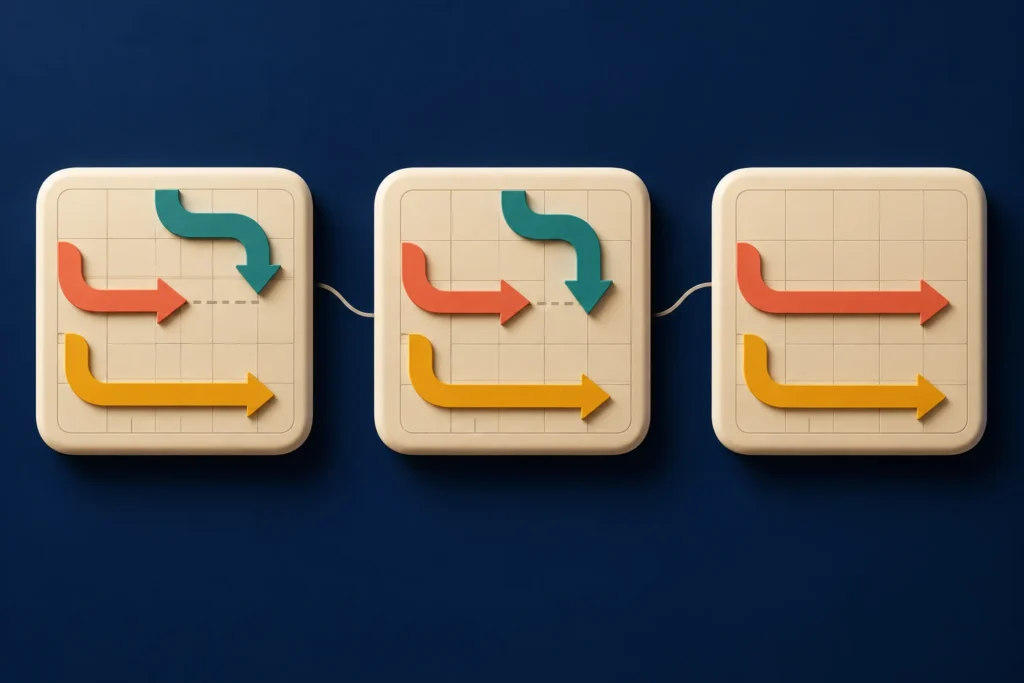
Imagine a clear piece that runs across a downward-pointing arrow’s route. You decide to remove the clear piece and then check the downward path. If nothing else is in the way, you’ve found your next move. If another piece still crosses it, you’ve learned what to look at next.
Now imagine a second clear arrow elsewhere on the board. You can choose either one. The first gives you a specific path to revisit; the second may be easier to see. Comparing them is useful, but you don’t need to find a single “perfect” move before continuing.
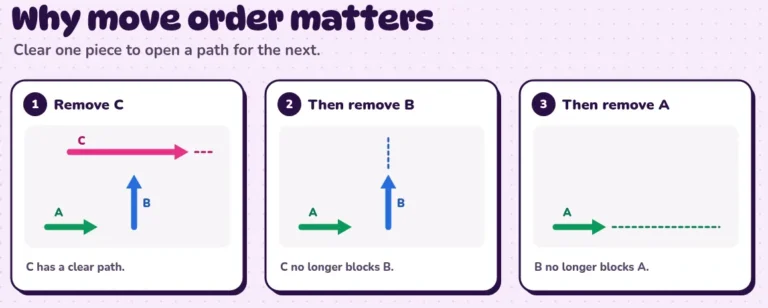
For a closer look at these choices, see why move order matters in Amaze Go puzzles.
Understanding How Pieces Affect Each Other
In an arrow puzzle, the piece you’re watching and the piece blocking it may be far apart. A small part of a winding line can cross the path ahead of an arrowhead, even when the blocking piece’s own tip is on the other side of the board.
Suppose a right-pointing arrow is blocked by a line near the right edge. Follow that line to find its arrowhead, then check whether the blocking piece can leave. If it can, removing it may clear the right-pointing arrow’s route. There could still be another blocker, so check the route again before selecting it.
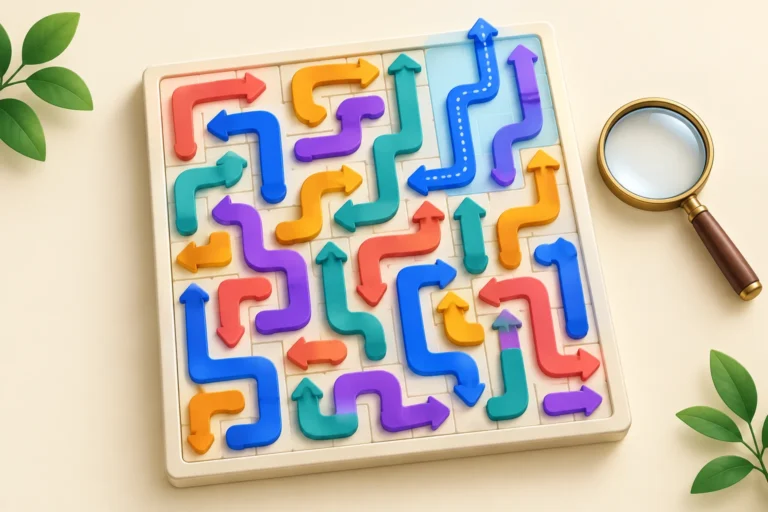
On a crowded board, it can help to inspect one area at a time while remembering that paths may extend beyond that area. The guide to solving crowded arrow puzzle boards offers practical ways to do this.
If you’re unsure which direction a winding piece will move, return to its tip. The beginner’s guide to reading arrow directions explains how to separate the arrowhead’s direction from the bends in its line.
Recognizing Possible Move Sequences
Some arrows depend on other pieces leaving first. When you find a blocked arrow, work backward: identify the blocker, check that piece’s direction, and see whether its path is clear. If it isn’t, look for what blocks that piece.
For example, you might find that a center arrow has two pieces crossing its path. One blocker can leave now; the other cannot. Removing the available blocker is a useful start, but the center arrow will still need to wait until the second path is dealt with.
Keep your sequence short and flexible. A helpful plan might be: “Remove this clear piece, then inspect the other blocker.” That gives you a reason for the move without requiring you to predict every step in the level.
For more advice on identifying available moves instead of guessing, read how to approach difficult puzzle levels without guessing.
Adjusting Your Plan When the Board Changes
Every removal gives you a new view of the puzzle. A long piece may have blocked a route you hadn’t noticed, or an arrow you expected to move next may still have another piece in its path.
Say you remove a blocker and expect the arrow behind it to be clear. On inspection, you notice a second line farther ahead. Don’t select the arrow out of habit. Update your plan: find the remaining blocker and check whether it can move.
You might also notice a newly clear arrow in a different section. If its full path is open, you can consider it alongside the move you originally planned. In Amaze Go gameplay, the goal is to clear every arrow, not to follow a plan you made before the board changed.
Practicing Strategic Thinking
You can practice planning ahead in puzzle games without turning every level into a long exercise. Try this routine on your next board:
- Find a clear move. Check the arrowhead’s direction and the entire path ahead.
- Make a small prediction. Notice one route that might open when the piece leaves.
- Remove the arrow. Select it only when you can see that its path is clear.
- Compare your prediction with the board. Check the route you expected to open, including any remaining blockers.
- Choose your next step. Continue with the new information, even if it differs from your original plan.
As you become comfortable, compare two clear moves or trace a short chain of blockers. If the board is hard to see, use the zoom controls and Pan mode to inspect it more closely. For more ways to practice observation and planning, explore problem-solving habits for puzzle games.
Good logic puzzle strategy is about staying curious, not predicting everything. Play Amaze Go and try making one prediction at a time. For additional help, browse the Amaze Go guides or the Where to Play page.
Comments (0)