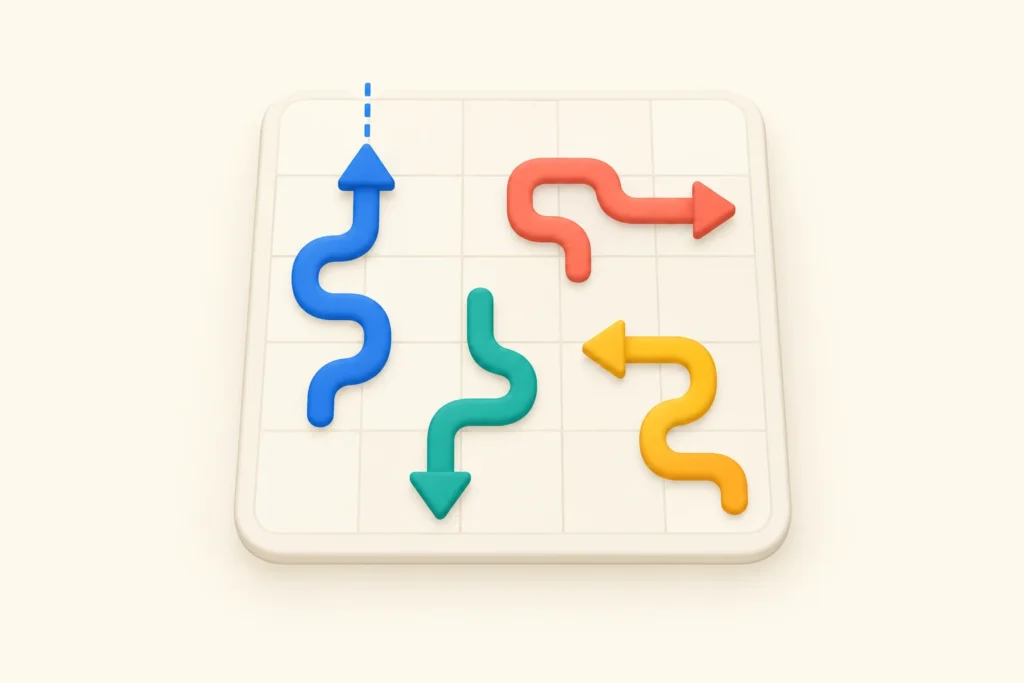
When you first look at an arrow puzzle, it’s easy to focus on the winding lines and wonder which piece to move. But there’s a simpler place to start: the tip of each arrow.
Learning to read arrow directions helps you see where a piece will go and whether anything is in its way. Once you know what to look for, even a busy board becomes easier to approach one move at a time.
Understanding Arrowheads
The arrowhead is the pointed end of a piece. It tells you the direction the arrow will move when you select it: up, down, left, or right.
In Amaze Go, an arrow can bend several times across the board. Its long line might run upward, but if the arrowhead points left, the direction to check is left.
When you’re unsure, find the pointed tip before looking at the rest of the piece. Take your time connecting the arrowhead to its winding line, especially when several pieces are close together.
If you’d like an introduction to the objective and controls, start with how to play Amaze Go.
Following the Direction of Each Arrow
Once you’ve found the arrowhead, imagine a straight line extending from its tip in the direction it points. That’s the route you need to check.
For example, if an arrowhead points down, look straight down from the tip toward the edge of the board. Don’t follow the bends in the arrow’s body to decide which way it will go. The arrowhead gives you the direction.
Try naming the direction to yourself before making a move: “This one points right” or “This one points up.” It’s a small habit, but it can help you avoid confusing neighboring pieces while you’re learning.
Checking the Space Ahead
An arrow pointing toward open space can leave the board only if its path ahead is clear. Look beyond the first gap beside the tip and check the whole straight route toward the edge.
Imagine a right-pointing arrow with an empty space immediately in front of it. If nothing else crosses its route before the edge, it has a clear path. You can select it to remove it from the board.
Now imagine the same arrow with part of another piece farther to the right. Even though the space next to the tip is empty, the route is blocked. In Amaze Go gameplay, selecting a blocked arrow costs a chance, so it’s worth checking the full path first.
For more examples of what to watch out for, see common mistakes players make in arrow puzzle games.
Recognizing Blocked Directions
A blocked direction means another piece is in the arrow’s path. The blocker doesn’t have to be another arrowhead. It may be any section of a winding arrow that crosses the route ahead.
Suppose an arrow points upward, but a horizontal line sits above its tip. The upward arrow cannot leave yet. Follow the blocking line to find its arrowhead, then check whether that piece has a clear route of its own.
If the blocking piece can leave, remove it and look at the upward arrow again. Its path may now be open, but there could still be another piece farther along the route. Check before selecting it.
Some blocked paths depend on several pieces. You don’t need to solve the whole chain in your head. The article on why move order matters in Amaze Go puzzles explains how to think through those connections one step at a time.
Practicing with Simple Puzzle Boards
The best arrow puzzle for beginners is one where you can comfortably see the individual pieces. Choose a board that looks manageable and practice finding arrowheads before you worry about speed.
For each piece you consider, use this short routine:
- Find the arrowhead and name its direction.
- Trace a straight line from the tip toward the edge.
- Look for another piece crossing that route.
- If the path is clear, select the arrow and watch it leave.
- Look at the changed board before choosing another piece.
Practice with arrows pointing in different directions. You might check an upward arrow first, then a left-pointing one. If a route is blocked, leave that piece alone and look for another clear move.
You can play Amaze Go in your browser and choose a level to practice. If finding a starting point is tricky, try the guide to finding the first move in a difficult level.
Building Confidence with More Difficult Levels
As you try busier boards, keep using the same basic skills. Pick one arrowhead, identify its direction, and inspect the entire path. You don’t have to understand every piece before making your first move.
If several arrows are close together, focus on a small area first. Use the zoom controls when a tip or crossing is hard to see. On a larger board, switch to Pan mode to drag the board and inspect another area; switch back to Scroll mode when you want to move down the page.
After removing a piece, revisit the paths it was blocking. A route that was closed a moment ago may now be clear. If it isn’t, keep looking for the remaining blocker instead of guessing.
With practice, reading arrow directions becomes quicker and more natural. For the next step in your arrow puzzle strategy, explore the Amaze Go guides or browse the Where to Play page for more helpful resources.
Comments (1)