
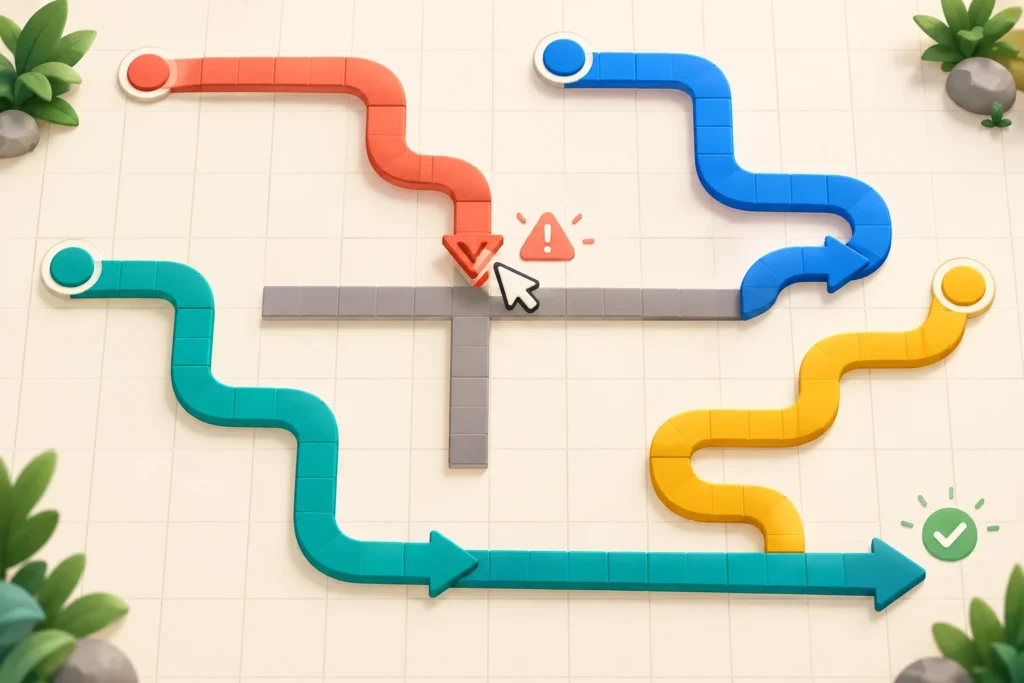
At first glance, an arrow puzzle can look simple: find an arrow and move it off the board. But once several winding pieces overlap and block one another’s paths, an obvious-looking move can turn out to be a mistake.
The good news is that most puzzle-solving mistakes come down to a few habits you can change. Slowing down, checking the full path, and taking another look after each move can make a crowded board much easier to understand.
Moving Arrows Without Checking Their Paths
It’s tempting to tap an arrow when the space right in front of it looks empty. But a clear space near the arrowhead doesn’t always mean the whole path is clear. Another piece may cross the route farther ahead.
For example, imagine an arrow pointing to the right. There’s nothing directly beside its tip, so you select it. Farther along that same line, however, another piece is in the way. In Amaze Go, selecting a blocked arrow costs a chance.
Before you move, start at the arrowhead and trace a straight line in the direction it points, all the way toward the edge of the board. Look for any part of another piece crossing that route. If you find one, leave the arrow for now and look for a different move.
Ignoring Other Pieces on the Board
Focusing on one arrow is useful, but it can also give you tunnel vision. An arrow that cannot move yet may depend on a piece somewhere else on the board. If you keep looking only at the blocked arrow, you may miss the move that helps it.
Suppose an arrow points upward, but a winding piece crosses its path. Instead of tapping the upward arrow again, find the arrowhead belonging to the blocking piece and check its route. If that route is clear, remove the blocker and then inspect the upward path again. There could still be another piece in the way.
It also helps to notice what a removable piece is blocking. If you have a choice between clear arrows, removing one that sits in front of several others may open up more options. You don’t have to plan the whole level at once; thinking one or two moves ahead is often enough to make the board feel more manageable.
Rushing Through Difficult Levels
When a board looks crowded, it’s easy to start tapping whatever seems likely to move. That might feel faster, but guessing can cost chances and leave you less sure about what to try next.
Imagine spotting two arrowheads close together. In a hurry, you tap one because its path looks mostly open, only to notice a crossing line after the move is blocked. A short pause before tapping would have given you time to check the entire route.
If you feel stuck, take a breath and choose one small area to inspect. Look for an arrow whose direction and path you can see clearly. If the lines are hard to distinguish, use the zoom controls for a closer view. Patience isn’t about playing slowly for the sake of it; it’s about giving yourself enough time to make a confident choice.
Forgetting to Recheck the Board
A move can change more of the board than you expect. A winding arrow may stretch across several areas, so removing it can open paths far from its arrowhead. If you continue using the same plan without looking again, you might overlook a newly available move.
For example, you may have noticed earlier that an arrow on the left was blocked. After removing a long piece on the right, you keep searching the right side and forget about the left. Part of that long piece may have been crossing the left arrow’s path.
After each removal, take a moment to scan the spaces the piece occupied. Revisit arrows that were pointing toward those spaces, and check their complete paths before selecting them. This small reset is one of the most useful habits for solving arrow puzzles without relying on old assumptions.
Misunderstanding Arrow Directions
Winding pieces can make it hard to tell which way an arrow will move. A line may bend upward and then turn sideways, so following the shape of its body can lead you to check the wrong direction.
Say you see a piece with a long vertical section and assume it will move upward. If its arrowhead actually points left, the important route is the straight line to the left of the tip—not the space above the vertical section.
Find the arrowhead first, then use its point to decide where to look. If you’re unsure which tip belongs to a winding piece, take a closer look before tapping. The How to Play Amaze Go guide is a useful starting point if you want to review the basics of directions and controls.
How to Develop Better Playing Habits
A good arrow puzzle strategy doesn’t need to be complicated. Try using the same short routine whenever you consider a move:
- Find the arrowhead. Make sure you know which direction the piece points.
- Trace the full path. Look straight ahead from the tip and check for any piece crossing the route.
- Identify blockers. If the path isn’t clear, find the blocking piece and see whether it can move first.
- Make a deliberate choice. Select an arrow when you can see that its path is open, rather than guessing.
- Look again. After the arrow leaves, check which spaces and paths have opened.
If the board still feels confusing, change where you’re looking. An arrow near the edge may have an easier path to inspect than one in the middle. You can also zoom in or use Pan mode to examine a larger board more closely.
These habits become more natural with practice. For more ways to approach a crowded board, explore the Amaze Go strategy guides, then return to play Amaze Go and put them to work one move at a time.
Comments (1)