A crowded Amaze Go board can make the first move feel difficult. Arrows point in different directions, their lines wind around the board, and other pieces may be blocking the paths ahead.
You don’t need to guess. A careful scan can help you find an arrow with a clear route and decide which move may open up the board. Here’s a practical way to make that first choice.
Why the First Move Can Be Difficult
At the start of a level, every piece is still on the board. A line that looks separate from an arrowhead may be part of a long, winding arrow elsewhere. That can make it hard to see which paths are open.
For example, an arrow pointing right might have empty space immediately beside its tip, but another piece could cross its path farther to the right. Selecting it without checking the whole route could cost a chance.
Start by looking for a move you can verify, rather than choosing the arrow that catches your eye first. If you’re new to the game, the How to Play guide explains the basic rules and controls.
Examine the Entire Puzzle Board
Before selecting anything, take a quick look at the whole board. Notice where the arrows are tightly packed and where there is more open space. Find a few arrowheads and note the direction each one points.
A useful place to start is near the outside of the board. An arrow pointing toward an open edge may have a route that is easier to inspect. But don’t assume every edge arrow is clear; another line can still be in its way.
If the board is difficult to see, use the plus and minus controls to adjust the view. You can also switch to Pan mode to inspect another area, then return to Scroll mode when you want to move down the page.
Identify Arrows with Clear Paths
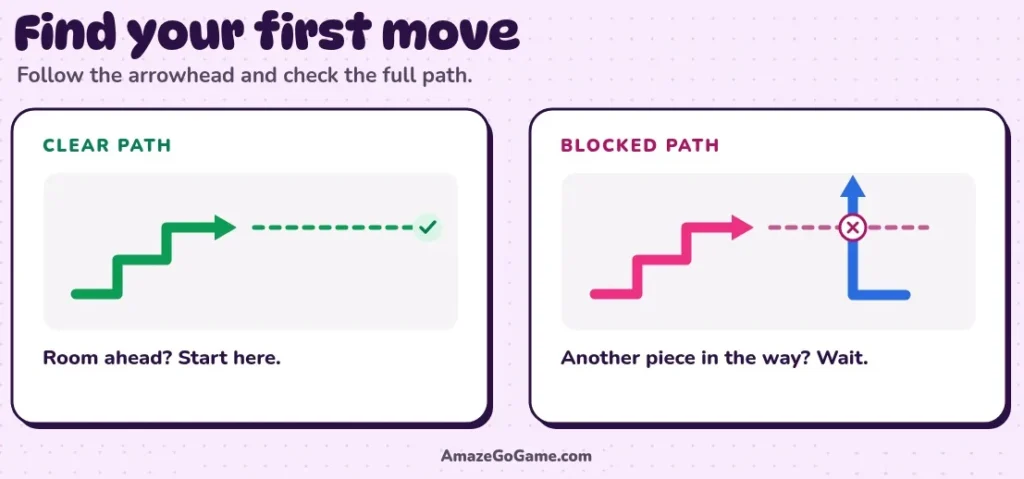
Choose one arrowhead and look straight ahead in the direction it points. Check the route across the board, not just the space directly next to the tip. If another piece crosses that route, the arrow is blocked.
If the route appears clear, you have found a possible first move. Look for a second clear arrow too. Comparing a couple of options can help you choose a move that opens useful space.
Hypothetical example: a clear route
Imagine an arrow near the right side of a board. Its tip points right, and no other piece lies between the tip and the edge in that direction. That arrow has a clear path and is a possible first move.
If another line crosses that route farther to the right, the arrow is blocked instead. The nearby space alone is not enough to make the move safe. This example illustrates the rule; it is not a solution for a particular level.
Look for Pieces Blocking Other Arrows
When you find a blocked arrow, identify the piece in its path. Then find that piece’s arrowhead and check its own direction. The blocker may be able to leave first, opening the route you wanted to use.
For example, imagine a left-pointing arrow whose path is crossed by a blue piece. The left-pointing arrow cannot leave yet. If the blue piece points upward and its path is clear, removing it may open the leftward route.
After the blue piece is gone, inspect the leftward route again. There may be another blocker farther along. For more help tracing chains of blockers, see the Amaze Go solutions guide.
Think About What Happens After Each Move
Sometimes more than one arrow has a clear path. In that case, look at the whole winding piece, not just its tip. A piece that crosses the paths of other arrowheads may be a useful one to remove early.
You don’t need to predict every move in the level. A short plan is enough:
- Find two arrows whose paths appear clear.
- Look along each winding piece to see whether it blocks another arrow.
- Choose one clear piece that may open another route.
- Remove it, then check the newly opened route before selecting again.
For instance, if a clear arrow crosses the path of a second piece, removing the first may make that second piece available. Another blocker could still remain, so recheck rather than assuming the next move is safe.
If neither clear arrow obviously helps another, choose a route you can see confidently and reassess after the move. The Amaze Go guides offer more ideas for planning around crowded boards.
Mistakes to Avoid When Choosing Your First Move
- Looking at the line but missing the arrowhead. Find the tip first, then check the direction it points.
- Checking only the nearest gap. Follow the route across the board; a blocker may be farther away.
- Staying in one crowded area. Scan another edge or open section if you can’t find a clear move.
- Rushing a selection. Pause when two lines are close together and zoom in if you need a better view.
- Repeating a blocked move. Look for the piece in its path instead of selecting the same arrow again.
These habits are useful throughout a level, not just at the start. For more quick ideas, explore the Amaze Go tips.
A Simple Method for Finding Your First Move
When a new board looks overwhelming, use this checklist:
- Look at the entire board and notice open and crowded areas.
- Find arrowheads and check the direction they point.
- Trace paths ahead to identify arrows that appear clear.
- Notice which pieces are blocking other arrows.
- Consider whether removing a clear piece may open another route.
- Select a sensible move whose path you can see clearly.
- Recheck the changed board before continuing.
If you have a question about blocked moves, controls, or saved levels, the Amaze Go FAQs provide quick answers.
Ready to Try It in Amaze Go?
Open a level, scan the board, and find one route you can follow with confidence. After that first arrow leaves, look again: the next useful move may be easier to spot.
Comments (2)