
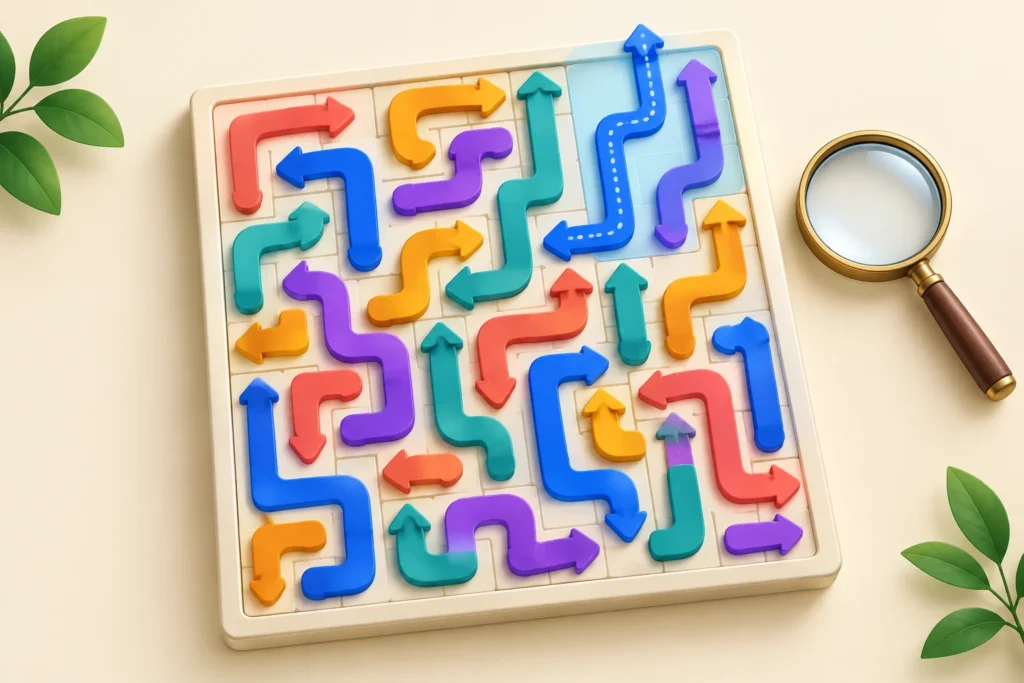
A crowded arrow puzzle board can feel confusing before you’ve even made a move. Arrowheads point in different directions, winding pieces cross the board, and the path you’re trying to follow seems to disappear among other lines.
The best response is to slow down and make the board smaller in your mind. You don’t need to solve everything at once. By focusing on one area, finding useful blockers, and checking each path carefully, you can turn a busy puzzle into a series of manageable decisions.
Why Crowded Boards Are Challenging
On a sparse board, it’s usually easy to see where an arrow points and whether anything is in its way. On a crowded board, the piece blocking an arrow might be a small section of a much longer line, with its arrowhead somewhere else entirely.
It’s also easy to mistake a nearby gap for a clear route. An arrow pointing left may have space directly in front of it, but a different piece farther along that same route could still prevent it from leaving. In Amaze Go, selecting a blocked arrow costs a chance.
Start by looking for the arrowhead, then trace a straight line ahead in the direction it points. If you’re new to the game, the Amaze Go rules and controls explain how to select arrows and clear the board.
Divide the Board into Smaller Sections
Instead of trying to read every arrow at once, mentally split the board into sections. You might start with the top left, move across to the top right, and then inspect the lower half. The sections don’t need exact boundaries; they’re simply a way to keep your search organized.
Within your first section, choose a few arrowheads and check the direction each one points. For example, if you’re looking at the top left and find an arrow pointing upward, trace its route toward the top edge. Then check the next arrowhead in that area.
Remember that a section is only a starting point. A piece in the top left might wind into the bottom half, and an arrow’s path may pass through several sections. Always follow the full route before deciding whether it is clear.
If you don’t find a move in one area, shift your attention to another rather than repeatedly scanning the same crowded spot. For a closer look at getting started, read how to find the first move in a difficult Amaze Go level.
Identify Important Blocking Arrows
Some pieces make a crowded area harder to read because they cross several arrow paths. These are useful pieces to notice: removing one may open more than one route or make nearby paths easier to inspect.
Imagine a long piece crossing the paths of two arrowheads near the center. Follow that piece until you find its arrowhead, then check the direction it points. If its own path is clear, it may be a helpful move to make early.
After the piece leaves, inspect both of the paths it crossed. One may now be open while the other still has a different blocker farther along. Don’t assume that either arrow is ready until you’ve checked its complete route.
If the important-looking piece is itself blocked, don’t force it. Find the piece in its way and check whether that one can leave. The Amaze Go guides offer more help with tracing blocked arrow paths and following chains of pieces.
Look for Open Paths
Finding an open path is less about spotting a large empty space and more about checking the right line. Pick an arrowhead and follow a straight line from its tip toward the edge of the board. If another piece crosses that line, the arrow is blocked. If the route is clear, you have a move you can make.
Arrows near the outside can be easier to inspect because their routes toward the edge may be shorter. For example, a right-pointing arrow near the right edge might be a good candidate. Check the space all the way to the edge, though; its position alone doesn’t guarantee a clear path.
When several routes appear open, compare the pieces before choosing. One may cross a path you want to clear, giving you a useful area to revisit after the move. Another clear arrow is still a valid choice, even if it doesn’t obviously open a nearby route.
If you catch yourself tapping because a path merely looks “probably clear,” pause and inspect it again. Our guide to common arrow puzzle mistakes covers other habits that can cost chances on busy boards.
Plan Moves Around Blocked Areas
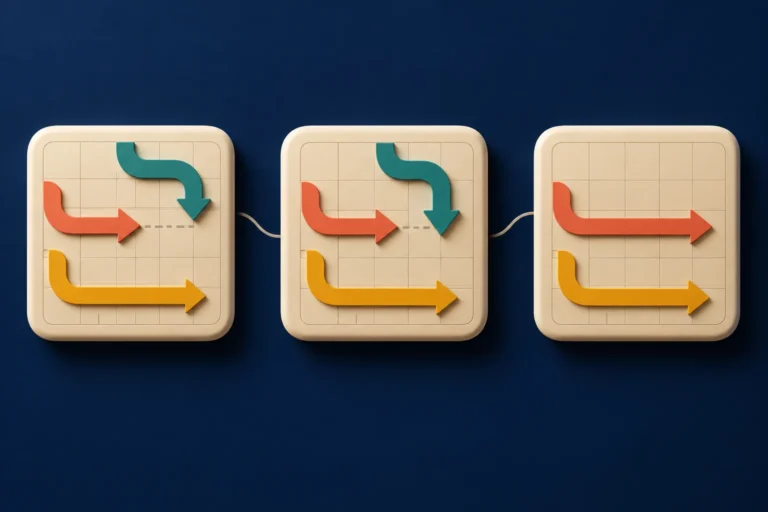
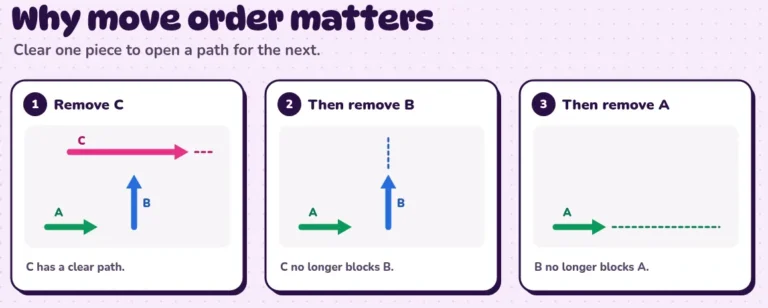
When an area looks impossible to clear, work backward from one arrow you want to move. Identify the piece blocking its path, find that piece’s arrowhead, and check whether its own route is open. If it isn’t, look for the next blocker.
For example, suppose an arrow in the center is blocked by a piece whose arrowhead is near the bottom. That piece is blocked too, but the piece in its way has a clear route. Remove the clear piece first, then recheck the bottom arrow. If its path is now open, removing it may help free the center arrow.
Think of this as a short plan rather than a promise that the next move will work. Each route may have more than one blocker, so check again after every removal. You may also find that a move in another section makes the crowded area easier to understand.
Every arrow needs to leave eventually, so a successful clear move isn’t necessarily wasted just because it doesn’t immediately open the area you’re watching. The goal is to avoid guessing and losing track of why a path is blocked. For more examples of choosing between available moves, see why move order matters in Amaze Go puzzles.
Use Zoom and Pan Controls Effectively
When lines are packed closely together, a different view can reveal a blocker you missed. Use the plus control to zoom in on an arrowhead or a crossing, and the minus control to zoom back out when you want to see more of the board.
For example, if two pieces look as though they touch the same route, zoom in to see which line actually crosses it. Then zoom out or move across the board to check the rest of the path before selecting the arrow.
On a larger board, switch to Pan mode and drag the board to inspect an area that is difficult to see. Switch back to Scroll mode when you want to move down the page. A closer view is especially helpful on a phone, where arrowheads and crossings may be harder to distinguish.
Ready to practice? Play Amaze Go in your browser, or browse the Where to Play page for links to more game guides. Take one section at a time, and let each clear move show you where to look next.
Comments (1)