
In Amaze Go, a clear arrow is more than a move you can make. It may also be the piece that opens the way for several others. Looking at those connections can make a crowded board easier to understand.
Move order is about recognizing which pieces need to leave before others can move. It is not always about finding one perfect sequence. Often, several clear arrows are available, and choosing one that opens another path can help you see what to do next.
1. Understanding the Importance of Move Order
Some arrows in an Amaze Go puzzle are blocked at the start. To remove one of them, you first need to clear the piece or pieces in its path. That creates a natural order: the blocker must leave before the arrow behind it can move.
When several arrows are available, you may be able to choose between them. Removing a piece that blocks other routes can make the next steps easier to spot. A different clear move can still be valid, even if it does not immediately open another path.
The important difference is between a clear move and a blocked one. Trying to move a blocked arrow costs a chance. If you need a refresher on the rules, visit the How to Play guide.
2. How One Arrow Can Block Another
Each arrowhead points in the direction its piece will leave the board. If part of another piece lies in the path straight ahead of that arrowhead, the move is blocked.
A blocker does not need to be a nearby arrowhead. It could be a section of a winding piece whose tip is somewhere else on the board. Follow the blocking line to find the arrow it belongs to, then check whether that arrow has a clear route.
Once the blocker is removed, look at the original arrow again. Its route may now be open, or another piece may still be in the way. Removing one obstacle does not always clear the entire path.
3. Finding the Right Sequence
Instead of choosing arrows at random, look for a short sequence you can explain: “This piece is clear, and removing it may open that path.” You only need to think a move or two ahead to make your next choice more purposeful.
When comparing two clear arrows, consider what each piece blocks. One might sit across the path of another arrow, while the other is away from the area you are trying to open. Removing the first piece may make that crowded area easier to inspect.
There can be more than one sensible sequence. Focus on making a move you have checked, then look at the updated board rather than relying on an old plan. The Amaze Go guides offer more ways to read a difficult board.
4. Recognizing Dependencies Between Arrows
An arrow depends on another piece when that piece blocks its route. The dependent arrow cannot leave until the blocker has been removed.
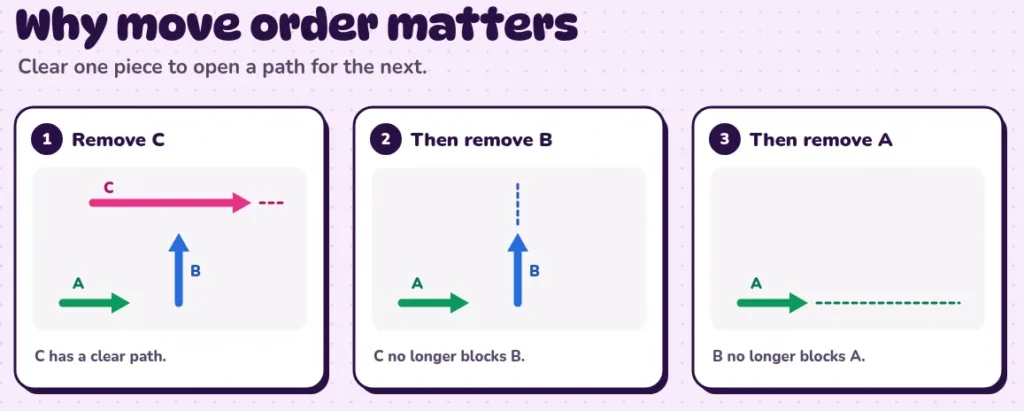
Imagine three pieces named A, B, and C. A is blocked by B, and B is blocked by C. If C has a clear path, removing C may allow B to move. Once B is gone, A may be available.
That gives you a possible order: C, then B, then A. Check each route before selecting it, because another piece could also be blocking B or A. This is a hypothetical example, not a solution to a specific level.
For help working through more complicated blockers, explore the Amaze Go solutions page.
5. Examples of Better Move Planning
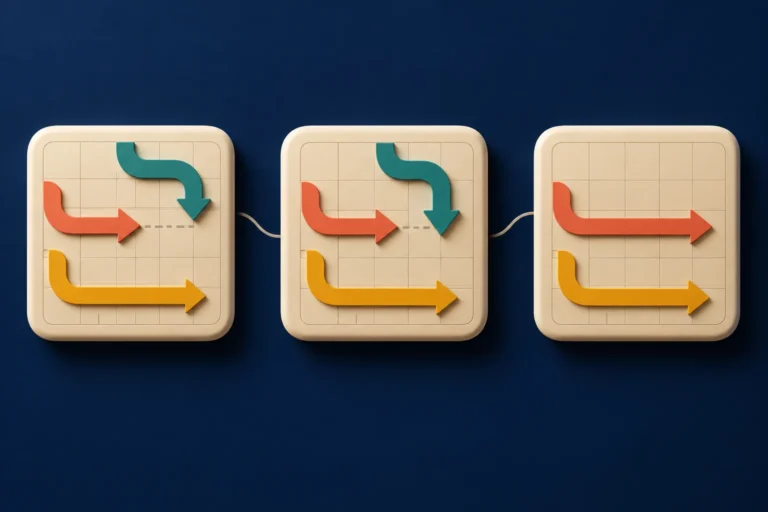
Consider a hypothetical board where two arrows, A and B, both have clear paths. A does not appear to block a nearby arrow, but B crosses the route of C. Removing B first may let you inspect C sooner.
A is still a valid move. Choosing B simply gives you a useful place to look next: the path that B was blocking. After B leaves, check whether C has any other blockers before selecting it.
Now imagine that C has two blockers, B and D. Removing B alone will not necessarily free C. A practical plan is to check whether D can also leave, remove the available blockers, and then inspect C’s full route again.
These examples show how planning can make the board easier to follow. They do not mean every puzzle has only one correct order, or that a particular move guarantees a win.
6. How to Avoid Unnecessary Moves
Every arrow must eventually be cleared, so a successful move is not necessarily wasted just because it opens no obvious path. The mistakes to avoid are unchecked attempts at blocked arrows and repeated selections that cost chances.
Before selecting a piece, ask yourself:
- Which direction does its arrowhead point?
- Is the full path ahead clear of other pieces?
- Does this piece appear to block another arrow I want to move?
- After it leaves, which route should I check next?
If the move is blocked, find the piece in its way instead of trying the same arrow again. You can find more practical advice on the Amaze Go tips page.
Ready to try a sequence? Play Amaze Go, choose a clear arrow, and watch which paths open after it leaves.
“`
Comments (1)